Diesel Particulate Filter (DPF) & DEF System Failures: Warning Signs and Fixes for Everett & Snohomish County Truck Owners
Diesel trucks working around Everett and Snohomish County can spend plenty of time in stop-and-go traffic, idling at jobsites, making short local trips, and hauling loads between communities. Those operating patterns can make emissions-system problems especially disruptive when a DPF warning, DEF fault, or engine derate suddenly appears.
Quick answer: DPF and DEF system warnings should be diagnosed rather than ignored or cleared repeatedly. A DPF may need a successful regeneration, professional cleaning, or repair of the underlying problem causing excessive soot. DEF faults can involve fluid quality, sensors, pumps, heaters, injectors, wiring, or other emissions-system components. Because several faults can produce similar dashboard warnings, proper diagnostics are the safest way to determine the actual fix.
What local truck owners should know
-
Frequent short trips and extended low-speed operation can make it harder for some diesel trucks to complete normal DPF regeneration cycles.
-
Trucks operating around Everett, Mukilteo, Lynnwood, Marysville, and other Snohomish County communities may encounter driving patterns that include congestion, local deliveries, and repeated stops.
-
A DPF warning does not automatically mean the filter needs replacement because another engine or emissions-system fault may be contributing to the problem.
-
DEF warnings should be addressed promptly because some unresolved emissions faults can eventually result in reduced vehicle performance or operating restrictions.
-
Diagnostic trouble codes are useful starting points, but testing the affected system is necessary before deciding which component or service is needed.
Why Do DPF and DEF Problems Matter for Everett Truck Owners?
DPF and DEF problems matter for Everett truck owners because an unresolved emissions fault can turn a manageable service issue into lost operating time, reduced engine performance, or a truck that cannot complete its normal route. For commercial vehicles in particular, downtime can interfere with deliveries, service calls, hauling schedules, and jobsite commitments.
Local operating conditions matter. A truck traveling long highway distances on I-5 may experience a very different duty cycle from one spending its day making short stops between Everett, Mill Creek, Lake Stevens, and nearby industrial or commercial areas.
That difference can affect how frequently the engine reaches conditions needed for normal regeneration.
Auto Truck Service Inc. helps truck owners address diesel performance and emissions-system concerns. Once a warning appears, we focus on determining what the system is actually reporting before recommending the appropriate service.
What Do We Commonly See With Local Diesel Emissions Systems?
Local diesel emissions problems often involve a combination of soot loading, interrupted regeneration, sensor faults, DEF-system problems, or an engine condition that prevents the emissions system from operating normally. These are professional field observations rather than published statistics about Snohomish County trucks.
A truck’s duty cycle is an important part of diagnosis. Repeated short runs, long idle periods, low-speed operation, and interrupted regeneration attempts can contribute to DPF-related problems on applicable vehicles.
Weather can matter to DEF systems as well. Snohomish County experiences cool winter conditions, and DEF systems are designed with components such as heaters to manage freezing conditions. A warning in cold weather should still be diagnosed rather than assumed to be normal.
How Can DPF or DEF Failure Affect a Local Truck?
A DPF or DEF failure can affect a local truck through warning lights, unsuccessful regeneration, reduced performance, increased downtime, and, depending on the vehicle and fault, eventual engine derate. The operational impact can be especially significant for work trucks that need to remain available every day.
A truck used for local deliveries around Paine Field, service calls throughout Everett, or hauling between Marysville and Lynnwood cannot generate revenue or complete scheduled work while sitting out of service.
Early diagnosis also matters because the visible warning may be the result rather than the original cause. Replacing an expensive component without finding that cause can leave the underlying problem unresolved.
What Are the Warning Signs of DPF and DEF System Trouble?
Common warning signs of DPF and DEF trouble include dashboard messages, frequent regeneration requests, reduced power, DEF-related warnings, check-engine lights, and regeneration that repeatedly fails to complete. Any persistent emissions warning deserves attention, particularly when the truck’s performance begins to change.
Watch for:
-
A DPF or exhaust-filter warning that remains illuminated.
-
Regeneration requests occurring more frequently than expected.
-
A parked regeneration that will not start or complete.
-
A check-engine or malfunction indicator light appearing with emissions warnings.
-
DEF level or DEF system messages that persist after the fluid level has been checked.
-
Reduced engine power or a derate warning.
-
Noticeably different exhaust-system behavior or repeated regeneration attempts.
-
Multiple emissions-related diagnostic trouble codes returning after being cleared.
A warning light alone does not identify the failed part. Modern diesel aftertreatment systems rely on multiple sensors and components that work together.
When Should You Call a Diesel Repair Professional?
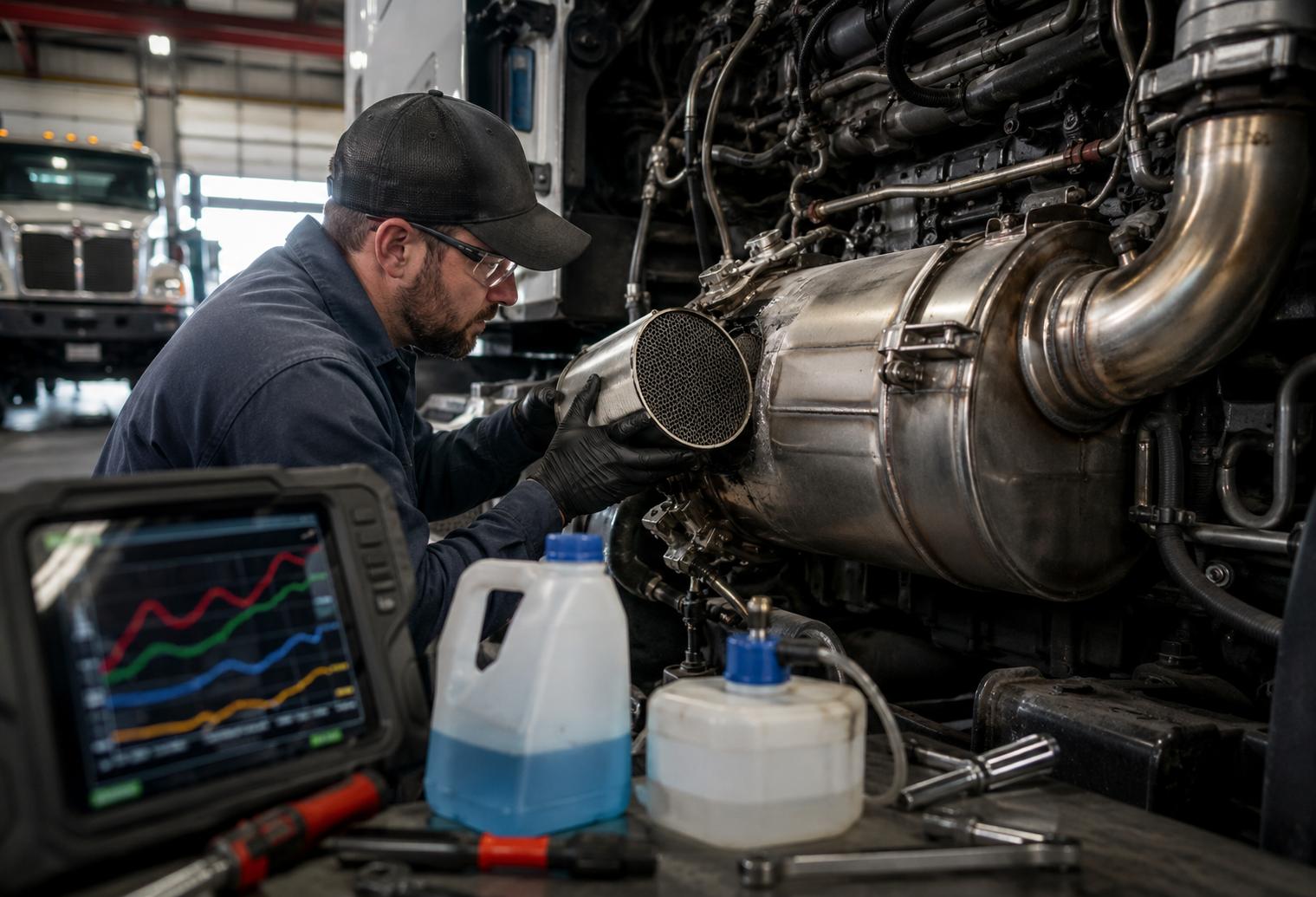
You should call a diesel repair professional when a DPF or DEF warning persists, regeneration repeatedly fails, diagnostic codes return, or the truck begins losing power or displaying derate messages. Drivers can safely check basic items such as DEF level and dashboard messages, but emissions-system diagnosis generally requires appropriate scan and testing equipment.
Do not repeatedly force regeneration without understanding why normal regeneration is not occurring.
A loaded DPF might be the immediate problem, but an engine operating issue, sensor fault, temperature problem, or other aftertreatment malfunction could be preventing successful regeneration.
For trucks that work throughout Snohomish County, arranging diagnosis before the vehicle reaches a severe derate can also make scheduling repairs less disruptive.
What Commonly Causes DPF and DEF Problems?
Common DPF and DEF problems can be caused by operating patterns, excessive soot production, failed or inaccurate sensors, regeneration problems, DEF delivery faults, or electrical and emissions-system component failures. The correct repair depends on identifying which condition is actually present.
1. Incomplete DPF regeneration
Local routes with frequent stops or limited sustained driving may not always provide favorable conditions for passive or active regeneration.
2. Excessive soot accumulation
If soot builds faster than the system can manage it, regeneration may become increasingly difficult. The underlying reason for excessive soot should also be investigated.
3. Sensor problems
Pressure, temperature, NOx, and other sensors provide information used by the engine and aftertreatment controls. Faulty readings can affect system operation and trigger warnings.
4. DEF delivery or quality concerns
Problems involving DEF delivery, contamination, incorrect fluid, injectors, pumps, heaters, sensors, or related components can generate system faults.
5. Wiring and electrical faults
Connectors, wiring, power supply problems, and communication faults can sometimes resemble a failed emissions component.
This is why code reading and diagnosis are not the same thing.
How Can Snohomish County Truck Owners Reduce DPF Problems?
Snohomish County truck owners can reduce avoidable DPF problems by following the manufacturer’s maintenance requirements, responding to regeneration requests, avoiding unnecessary extended idling, and addressing engine or emissions warnings early. Maintenance cannot prevent every component failure, but it can reduce the chance that a small problem goes unnoticed.
Drivers should understand the regeneration instructions for their specific truck. Procedures and requirements differ between engines and manufacturers, so the owner’s manual should take priority over generic advice.
It also helps to monitor:
-
Changes in regeneration frequency.
-
Persistent check-engine lights.
-
DEF consumption that seems unusual for the truck’s normal operation.
-
Recurring diagnostic messages.
-
Engine performance changes.
-
Required engine oil and fuel-system maintenance.
DIY work should stop when diagnosis requires emissions-system testing, forced regeneration procedures, component removal, or determining why a fault repeatedly returns.
What Results Can You Expect After DPF or DEF Service?
After proper DPF or DEF service, truck owners should expect the identified fault to be addressed and the system’s operation to be verified rather than simply having a dashboard code erased. The actual repair may range from correcting another engine problem to servicing the filter or repairing a failed aftertreatment component.
A DPF that is serviceable may not necessarily require replacement. Likewise, a DEF warning does not automatically mean that one particular sensor or component has failed.
The goal is to identify the root cause, perform the appropriate repair, and confirm how the system responds afterward. Results depend on the truck, fault, component condition, and manufacturer’s requirements.
What Mistakes Should Diesel Truck Owners Avoid?
The biggest mistakes are ignoring warnings, repeatedly clearing codes, assuming every DPF problem needs a new filter, and replacing DEF components without confirming the failure. These approaches can increase downtime without correcting the reason the warning appeared.
Mistake: Continuing to drive while increasingly serious derate warnings appear.
Consequence: The truck may eventually face greater operating restrictions.
Better approach: Arrange diagnosis while the vehicle is still reasonably serviceable.
Mistake: Treating regeneration as the solution to every DPF code.
Consequence: The regeneration may fail again if another fault caused the soot problem.
Better approach: Determine why the DPF became overloaded or could not regenerate.
Mistake: Replacing a component based only on a fault code.
Consequence: The new part may not solve a wiring, fluid, sensor-data, or related system problem.
Better approach: Test before replacing parts.
What Is a Common Local DPF Scenario?
A common local scenario is a diesel work truck that spends much of its week making short trips and idling between jobs, then begins requesting regeneration more frequently. This is an illustrative scenario, not a specific Auto Truck Service Inc. customer case study.
Imagine a truck moving between Everett jobsites and nearby communities such as Mukilteo and Mill Creek. The driver notices a DPF message but keeps working because the truck still runs normally.
Eventually, the warning returns along with a check-engine light or reduced-performance message.
At that point, simply attempting another regeneration may not answer the important question: why is the truck having difficulty managing soot? Diagnosis can help separate a duty-cycle issue from a sensor, engine, or aftertreatment problem.
Which Services Can Address DPF and DEF Problems?
DPF and DEF problems may require diagnostic testing, regeneration-related service, DPF cleaning or replacement when appropriate, and repair of sensors, electrical faults, DEF components, or underlying engine issues. The exact service should follow diagnosis instead of being selected from the dashboard warning alone.
For a DPF concern, that means determining filter loading and checking conditions that affect regeneration. For DEF concerns, it means evaluating the relevant aftertreatment system rather than assuming the warning identifies the failed component.
Should You Try a DIY Fix or Schedule Professional Diagnosis?
Basic checks can be handled by the driver, but persistent DPF and DEF faults usually call for professional diagnosis because multiple components and operating conditions can trigger similar warnings. Knowing where DIY troubleshooting should stop can prevent unnecessary parts replacement.
A driver can review the dashboard message, confirm DEF level, consult the owner’s manual, and note when the warning occurs.
Professional service becomes the better option when warnings persist, codes return, regeneration cannot complete, power is reduced, or testing requires specialized equipment.
For commercial trucks, diagnosing the cause early can also be more practical than waiting until an Everett-area route is interrupted by a severe operating restriction.
Where Do We Help Truck Owners in the Everett Area?
We help truck owners dealing with diesel service needs in Everett and the surrounding Snohomish County area. Nearby communities may include Marysville, Lake Stevens, Mill Creek, Mukilteo, and Lynnwood, depending on the service needs and location.
Truck owners operating along I-5 and throughout the county can benefit from addressing emissions warnings before they interfere with scheduled work.
What Can Happen If You Ignore a DPF or DEF Warning?
Ignoring a DPF or DEF warning can allow the underlying problem to continue until the truck experiences greater downtime, more difficult regeneration, reduced performance, or an emissions-related operating restriction. Waiting can also complicate diagnosis if several related faults develop over time.
That does not mean every warning signals an immediate major repair. It means the warning should be treated as useful diagnostic information.
For an Everett work truck with a full schedule, getting the problem evaluated while the vehicle remains operational may provide more flexibility than waiting for a derate or unsuccessful regeneration to disrupt the day.
Frequently Asked Questions About DPF and DEF Problems
Can I keep driving with a DPF warning in Everett?
You may have limited driving capability with some DPF warnings, but the correct response depends on the truck and the specific warning. Follow the manufacturer’s instructions and do not ignore escalating messages, reduced power, or derate warnings. If regeneration does not resolve the issue as specified by the manufacturer, schedule diagnosis.
Why does my DPF warning keep returning on local Snohomish County routes?
A recurring DPF warning can indicate that regeneration is not completing or that another engine or aftertreatment problem is contributing to soot accumulation. Short-trip and low-speed duty cycles can be relevant, but they should not automatically be blamed. Recurring warnings deserve diagnostic testing to identify the actual cause.
Does a DPF warning mean my filter needs replacement?
No, a DPF warning does not automatically mean the filter needs replacement. Depending on its condition and the cause of the problem, the appropriate response could involve regeneration, cleaning, another repair, or replacement. Testing should determine filter condition and identify any underlying fault before an expensive component is replaced.
Can Everett stop-and-go driving affect DPF regeneration?
Stop-and-go operation can make DPF management more challenging on some trucks if the vehicle does not regularly achieve the conditions required for successful regeneration. Actual regeneration strategies vary by manufacturer and engine. Drivers should follow their vehicle’s instructions rather than attempting generic regeneration procedures found online.
Why is my DEF warning still on after adding DEF?
A DEF warning that remains after the correct fluid level is restored may indicate something other than a low-fluid condition. Depending on the vehicle, possible areas requiring diagnosis include fluid quality, sensors, heaters, pumps, injectors, wiring, or other SCR and aftertreatment components. Diagnostic testing can narrow down the fault.
What should I do if my truck goes into derate in Snohomish County?
Follow the vehicle manufacturer’s instructions and arrange professional diagnosis as soon as practical when a truck enters derate. Continuing operation may be restricted depending on the fault and system strategy. If the truck is used commercially around Everett or nearby communities, prompt service can help minimize additional schedule disruption.
Can a forced regeneration fix every DPF problem?
No, a forced regeneration cannot fix every DPF problem. It may be appropriate in certain conditions, but regeneration will not repair a failed sensor, wiring issue, engine fault, damaged component, or another condition preventing proper aftertreatment operation. Repeated regeneration without diagnosis can leave the underlying problem unresolved.
How can I prevent DEF system trouble during Snohomish County winters?
Use the correct DEF, follow manufacturer maintenance instructions, and address cold-weather DEF warnings that persist rather than assuming they are harmless. DEF systems are designed to accommodate freezing conditions, but heater, sensor, electrical, and delivery-system faults can still occur. Persistent warnings should be properly diagnosed.
DPF and DEF systems are complex, but responding to warning signs does not have to be complicated. For truck owners working in Everett and across Snohomish County, early diagnosis can help identify the actual fault, reduce unnecessary parts replacement, and limit avoidable downtime.
Keep Your Everett Diesel Truck Working With Fewer Emissions-System Surprises
We can help identify DPF and DEF problems before recurring warnings create greater disruption to your work schedule.
Categorised in: Vehicle Maintenance